Showing posts with label average. Show all posts

Sunday, 4 November 2018

S2-L25 Statistics Practice : Average


(Part 1) TEACHING(10-15mins)                
1.  Relationship between average, total value of data, word problems

(Part2) PRACTICE (20-35mins)
Find the average of:
1.   38, 41 and 44

2.   $130, $125, $108

3.   38kg, 37kg, 44kg, 41kg

4. The table shows the amount of money John saved from January to April.

What was the amount of money John saved in May if the average amount of money he saved from January to May is $32? (15/p1/18f)
(1) $25     
(2) $32     
(3) $64     
(4) $160                                                                                       (                       )

5.  The weight of Parcel A is 6 kg. Parcel B is as heavy as Parcel A. Parcel C is twice as heavy as Parcel B. What is the average mass of the 3 parcels?

6.  The average cost of 3 magazine is 8$. The total cost of 2 of the magazine is $6.8. What is the cost of the third card?

7.  The average mass of 5 boxes is 225g. What is the total mass of the 5 boxes?

8.   Remy spent an average of $3 per day from Monday to Friday. He spent an average of $5 per day for Saturday and Sunday. How much did he spend in one week? (23/p1/s18)

9.The average number of mangoes in 5 baskets was 53. Whenanother basket of mangoes was added, the average number of mangoes became 49. How many mangoes were there in the last basket? (/183/p2/s)

Extra Practice
1. *  The average of 9 numbers is 140. One of the numbers is 180. What is the average of the other 8 numbers?

2.  Amy scored an average of 80 marks for 3 tests. She scored 82 and 75 mars for the first two tests. What was her score for the third test?

3.*  Calvin bought some goldfish at $10 each. He also bought an equal number of angelfish at a different price. The average price of a goldfish and an anglefish was $7.
Calvin paid $54 more for the goldfish than the anglefish. How may goldfish did he buy?

4.  The pass of Parcel A is 6 kg. Parcel B is as heavy as Parcel A. Parcel C is twice as heavy as Parcel B. What is the average mass of the 3 parcels?

Answer Keys
1.            41
2.            121
3.            40 kg
4.            1
5.            8 kg
6.            $10.40
7.            1125 kg
8.            $25
9.            29

Monday, 1 October 2018

ST4 Mathematics Statistics : Average


Average
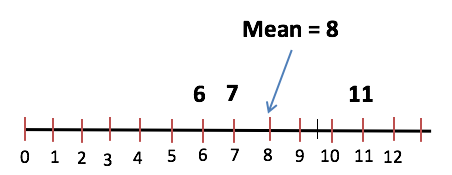
What is the average of 6, 11, 7?

    Average is like you are "flattening out" the numbers -> sharing total values equally


Why Use Average
(1) It is a “central” value of a sample set. 

(2) It is “fair sharing”, pulled by up large values and brought down by the smaller values.

Compute Average
Step 1: Total Value : Add all the values of the numbers -> 6+7+11 = 24
Step 2: Count of Data  = 3 (there are 3 numbers - 6, 11, 7)
Step 3: Divide the Total Value by the Number of Data
Average = 24/3 = 8
Formula
       Average =  Total Amount/Value/Quantity/Set of numbers  
                                Count of shares/items           

Example:
A dice is thrown 10 times. The following results are obtained:
               5, 5, 1, 2, 6, 4, 2, 3, 4, 1
What is the average score?
               Step 1: Total Value =5+5+1+2+6+4+2+5+4+1 = 35
               Step 2: Count = 10
               Step 3: Average = 35/10 = 3.5

Example:
What is the average of 5, 8 and 11?
                Step 1: Total Value = Add the numbers: 5 + 8 + 11 = 24
                Step 2: how many numbers (i.e. we added 3 numbers) =3
                Step 3:  Average  = 24/ 3 = 8

Example:
Five students have the following number of sweets:
     A:   9
     B:   2
     C:   7
     D:   4
     E:   3
a.   What is the number of sweets that each can have for equal sharing? (Average)
            Average = 9 + 2+ 7 + 4 + 3 
                                       5
                         = 25/5 
                         = 5
b.   Who has the most sweets? (mode)
            Student A
c.   What is percent of sweets that Student B has?
            Percent = Number of sweets of Student B x 100
                                   Total Number
                          =  2  x 100 
                             25
                          = 8%
d.   Both Student B and C gave away their sweets. What fractions of the total number of sweets have been given away?
Sweets given away = 2 + 3 
                                               25 
                                   = 1/5
e.  What is the new average?
            Average = 9 + 0 + 7 + 4 + 0 
                                      5
                           = 20 /5 
                           = 4 sweets
Practice
Find the average :
(1) 12, 15, 24 and 13                                              ­­­­­­­­­­­(12+15+24+13) / 4 =16
(2)  34, 56 and 33                                                    (34+56+33) / 3 = 41
(3) 36cm, 47cm, 38cm and 51cm                         (36+47+38+51) / 4 = 43


AVERAGE COMPUTATION – WORD PROBLEM


                         Average = Total  Value
                                            Count of Data           
Method:
Step 1: Total Value : Add all the values of the numbers -> 6+7+11 = 24
Step 2: Count of Data  = 3 (there are 3 numbers - 6, 11, 7)
Step 3: Use the Average Formula

Example
10 textbooks cost $6 each and 20 notebooks cost $2 each. 
What is the average cost of each item ?
            Step1: Total Value = (10 x $6) + (40 x $2) = $60 + $80 = $240
            Step2: Count of Data = 10 + 40 = 50
            Step 3: Average = total value / items = $240 / 50 = $4.80

Example
Mary bought 4 skirts at $65 each and 1 blouse at $45 each. 
What was the average cost of the items ?                 
Total Value = (4x $89) + (1x$45) = $305
Number of items = 5
Average = $305/5 = $61


COMPLEX AVERAGE WORD PROBLEMS
The more complex Average Computation questions usually involve 2 objects with different their average values, or to find a specific average of 1 object with the information from another object.
The average-table is to help learners understand how the value of different objects are related when using the average formula. That is, it is to be used as a working table to determine the linkage of an unknown value and given data via the average formula.
It may seem complicated, but it is the average formula (for more than 1 data) in table form.
The Average-Table
Object?
Value of 1 data or average value
Count
Total Value
Average of all items
Item1
A
B
AxB

(AxB) + (CxD)
Item2
C
D
CxD
      (B+D)

Combined Total
B+D
(AxB) + (CxD)


How to fill in the table?   Example/Explanation:
The average height of 8 men is 1.72m. If one of them is 1.6m tall,
what is the total height of the other 7 men?
The object is usually the item with the number count,
            Example: 8 men, 4 pens, 5 books
            The items are men, pens, books, and the number count is 8,4,5.
            Value = Value of each of the object.
            Total value = Each Value x Count or Average value x Count
             -> the average of an item can be used to compute the total value of specified item
            Average of all items = Sum of Total Value/Total Count.
Method:
Step1: Draw table and fill in information from question
Step2: Let U be the missing value/required value
Step3: Use the average formula to find the answer

Example:
Step 1:           Fill in the table with the information from the question

object?
Value/Avg
Count
Total value
Average Price
7 men

7
U
1.72
1 man
1.6
1
1.6


Total
8
U + 1.6


Step2: Let U be the value missing
            Let U be the total height of the 7 men
Step3: Use average formula to find the answer
            Total Height of 8 men = Average height x Total number
                        U + 1.6 = 1.72 x 8
                        U = 12.16 
Total height of the other  men = 12.16m

Example
The average length of 6 ropes is 168 cm. The average length of 4 of the ropes is 172cm. What is the total length of the other two ropes ?
Step 1:           Draw and fill table
Obj
Val/Avg
Count
Total
Average
4ropes

4
172 x 4
168
2 rope

2
U

Total

6
172x4 + U


Step2: Let U be the total length of the other 2 ropes
            Total length of the other 2 ropes   ->   Total length of 6 ropes – Total length of 4 ropes
Step3: Use formula to find the answer
            172x4 + U  = 168 x 6
            U = 320cm

The total length of the other 2 ropes is 320cm.

Practice: (when doing question – Draw the Average-Table at the working area)
The average mass of 9 children is 42kg. If the masses of 3 of them are 37kg, 46kg and 42 kg, what is the average mass of the other 6 children? Express your answer to 1 decimal place.

Val/Avg
Count
Total Mass
Average mass
 3 C

3
37+46+42
42
6 C
U
6
6U

Total

9
6U + 125

Total mass = 9 x 42= 378kg
37+46+42 = 125kg
Let U be the average mass of 6 children
6U + 125 = 378
            6U = 253
              U = 42.2 kg
            The average mass of 6 children is 42.2 kg
    ~~~~ END ~~~~ :)