Showing posts with label fraction word problems. Show all posts

Sunday, 4 November 2018

F4-L10 Fractions Practice : Division and Word Problems


(Part 1) Revise (~15mins)                                            Start Time : 

2. Solving 2-step word problems

(Part2) Practice (~50mins)

(I) Multiplication/Division (~15 mins)                               Working
1.      2 ÷                           2 .        2 x 1                                       
                3                                            3

3.      6 ÷                            4.         6 x 4               
               5                                              5

5.      12 ÷                          6.         12 x 6
                 7                                              7        

7.      1 ÷ 3                             8.          3
         2    4                                          2    4


9.      5 ÷ 7                             10.   5 ÷ 7
         6  12                                     6   12


11.    ÷ 8.                          12.  7 ÷ 14
         5    15                                18     15
13.     20 ÷ 6
                  5

(II) Word Problems/PSLE (~35 mins)                   Start Time:                             
14.         Mariam has a piece of rope 10 m long.
She cuts them into equal pieces, each 7/6 m long, except for the last rope which
is less than 7/6 m long. What is the length of the last rope? (6/p2/18f) 

15.         A string was 3m long. Zoe cut it into pieces of length 1/9 m long each. How many pieces did she get?

16.         The product of two numbers is 4/5. If one of the numbers is 5/6, what is the other number?

17.         4 cakes were shared among a group of children. Each child got 2/9 of a cake. How many children were there in the group?
18.         Zack spent 1/3 of his money on food. He then used 1/4 of the remainder to buy 3 breads. What fraction of his money did he spend on each bread?

19.         Find the value of 1/6 ÷ 4/9. Give your answer in the simplest form. (16/p1/18s)

20*.       Find the value of 4/5 ÷ 12. Give your answer as a fraction in the simplest form.

21.         The selling price of each cup of lemon juice is 3/2 times as much as the selling price of a cup of apple juice. For every 2 cups of lemon juice sold, Mr Tan sells 5 cups of apple juice. He earns $12 more from apple juice than from lemon juice. How much does Mr Tan earn altogether? (7/p2/18s)

22.         A fruit seller had 33 more watermelons than papayas. After he sold 1/3 of the watermelons and 4/5 of the papayas, he had 57 more watermelons than papayas. How many papayas did he have at first? (10/p2/18s)
Extra Practices
 (1)    'Equal/Same' Word Problems  (optional) 

 (2)    General Word Problems  (optional)
1.     35 ÷ 5
                7

2.   45 ÷    12
                  5

3.  Ken bought 24kg of peanut. He sold 3/8 of it and packed the remaining peanut into smaller packets of 4/5 kg each.
            a. How many packets of peanut are packed? 
            b. How much peanut was left unpacked?

4.         Jane has a number of happy face stickers in three colours: yellow, orange and red. 2/7 of the stickers are yellow. The number of yellow stickers is twice the number of orange stickers. What fraction of the stickers are red?

5.         A fruit seller had 33 more watermelons than papayas. After he sold 13 of the watermelons and 4/5 of the papayas, he had 57 more watermelons than papayas. How many papayas did he have at first?

6* A shop had a number of computers for sales. After selling 32 of them in the morning and 5/8 of the remainder in the afternoon, it was left with ¼ of the computers. How many computers were sold altogether?

7.         The fraction 2/ lies between 1/8 and 1/9. Find the missing whole number in the box. 

8.         3/5 of the children in the playgroup were boys. The instructor divided the boys equally such that each group of boys had 1/10 of the number of children in the playgroup. The instructor then divided the girls equally into groups such that each group of girls had 1/5 of the number of children in the playgroup.        
            (a) Find the number of groups of boys and girls
            (b)  If there were 16 girls in the class, how many boys were there in the group?

9.         Every month, Peter spends 1/3 of his salary, save 3/8 of the remainder and shares the rest of his salary equally among his father, mother and sister. 
            a.  What fraction of his salary does each of them receive?
            b.  If his salary is $5400, how much does he give his sister each month?
Answer Keys
1.  6
2.  2/3
3.  15
4.  4 4/5
5.  14
6.  10 2/7
7.  2/3
8.  3/8
9.  2 11/12
10.  1 3/7
11.  3/4
12.  5/12
13.  16 2/3
14.  4/7 m
15.  27
16.  24/25
17.  18
18.  1/18
19.  3/8
20.  1/15
21.  
22.  120

Monday, 1 October 2018

F5 Fraction Word Problems Using Models and Common Terms


Fractions Terminology

 Fraction       :                       Numerator
                                             Denominator
                                                              

There are two numbers in a fraction

            n: numerator = how many of the equal parts are shaded
            d: denominator = how many equal parts the total is split into

If the fraction is spelt in words, the numerator Is usually the number and the denominator is expressed with an additional suffix : -th added to another number.

Example: two-fifth -> 2/5

Fraction of a Whole


 Fraction of a Whole with associated Total Number

=>In Model Representation,
            The numerator is the shaded portion
            The total number of squares is the denominator

Comparison Terms (With Associated Total Number)

Using Model to solve  Words Problem/Problem Sums

Example:
There are thrice as many apples as orange.
The word ‘thrice’ is used to describe apples, the nearest object(actor) =>
a. There are 3 apples to every 1 orange
b. When there are 3 apples, there is 1 orange

Example:
There are 3 times more apples than oranges. There are 8 apples. How many oranges are there?

The word ‘3 times’ is used to describe apples. The term ‘more’ can be explained as:
 adding 3  to the existing number  -> 1+3

                
Method:
Step 1:  Who/What and the Numbers? Underline/Circle and write.
Step 2:  What is the story? Draw Model and link
Step 3: (S)olve.


Example
12 fruits are in a basket. There are thrice as many apples as bananas.  How many apples are there?
Step 1 – Who/What and the NumbersUnderline/Circle and write..   => Apple, Banana
            Who/What  number
             Apple
            Banana
Step 2 – What is the story? Draw Model and link
The word ‘thrice’ is used to describe apples. 

There are  thrice   as many   apples   as bananas.
            Who number
             Apple       3u
            Banana     1u
Step 3Solve
There are 12 fruits        
            3u + u = 12 ,
   4u = 12.
      u=3.
 There are 3x3 = 9 apples


Example:
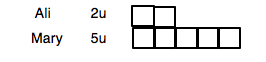
Ali had   2/5 as many stickers as Mary.  Ali has 6 stickers. How many stickers does Mary has?
Step 1 – Who/What and the NumbersUnderline/Circle and write.  => Ali, Mary
            Who  number
             Ali
            Mary
Step 2 – What is the story? Draw Model and link
Ali has 2/5, Mary has 1 -> Ali has 2, Mary will have 5
             Ali          2u
            Mary       5u
Step 3: (S)olve.

            Ali has 6 stickers
            2u = 6
             u = 3

Therefore, Mary has 5x3 = 15 stickers.
Example
There are 4/7  as many adults as children on the bus. There are a total of 33 of them on the bus. How many are children?
Step 1 – Who/What and the NumbersUnderline/Circle and write.  => Adult, children
            Object  number
            Adult
            Children
Step 2 – What is the story? Draw Model and link
   4/7 as many adults as children=> 4 adults to 7 children
             Adult         4u
             Chlldren    7u
Step 3: (S)olve.
Total of 33
            4u + 7u = 33
                  11u = 33
                        u = 3
There are 3 x 4 = 12 children on the bus

Practice

Mary has four times more apples than Peter.  There are 12 apples. How many apples does each has? 

Answer : Mary has 10 apples and Peter has 2 apples.
==========================================================
What is U?
There is usually a certain fixed quantity ‘bundled’(U) together for comparison between the different objects.

Example
There are 3 times more apples than oranges. There are 8 apples. How many oranges are there?
This example can be shown in table form:

Orange
Apple
Unit
1
4
1
2
8
2
3
12
3
4
16
4

The table shows that apples are 3 times more than orange.
Thus for 1 unit there is 1 orange and 4 apples.
For 2 units, there is 2 oranges and 8 apples, etc.
When U=2, there are 8 apples , oranges  = 2.

                      Thus, U defines the “bundled” quantity.
=========================================================